

Growing from adversity: An interview with General Rhonda Cornum, MD, PhD
by John D. Kelly IV, MD
As part of the inaugural edition of this exclusive series, I chose to interview retired Brig. Gen. Rhonda Cornum, MD, PhD, a decorated war veteran and, frankly, my hero.
Cornum was serving as an Army flight surgeon in Iraq in February 1991 when her Blackhawk helicopter was shot down by enemy forces. She survived the crash but was rendered unconscious. She awakened to discover that she suffered two fractured arms in addition to a gunshot wound to the back. Cornum was taken prisoner and endured sexual assault and other traumaticexperiences.
Cornum not only survived her brutal ordeal and captivity but maintains that she emerged “better” as a result of this inordinate adversity.
For 3 decades, Cornum has studied growth through adversity and has shared her message of hope with countless soldiers. Her message of cultivating resilience and growth after trauma will resonate with surgeons who are embracing an ever-increasing set of challenges.
Kelly: Tell us a little about yourself and your general disposition.
Cornum: I have always tried to look at the brighter side of life and have always seen challenges as simply “one more thing to overcome.” When adversity strikes, there is always something you can do about it. I did not become fully invested in the science of “post-traumatic growth” until several years after my military experience. However, I am living proof that one can grow from traumatic events. Sitting here today, I can honestly say that from my combat experience, I became a better doctor, a better parent and a better spouse.
Post-traumatic growth is not a new concept and even dates back to Nietzsche who famously stated, “That which does not kill is makes us stronger.” More recently, scientific articles have been written on the subject and, thankfully, skills which nurture growth can be learned.
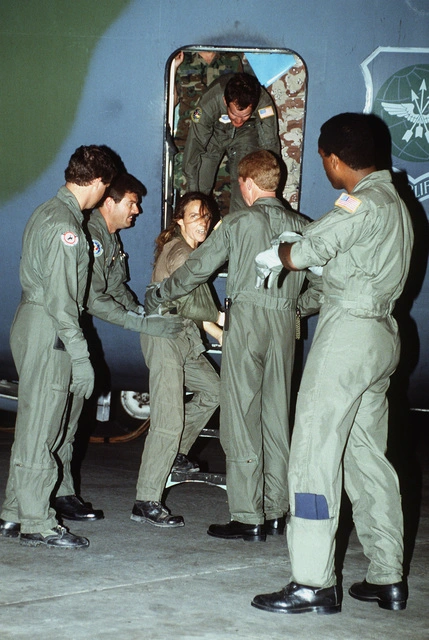
C-141B Starlifter transport aircraft after their release
by the Iraqi government during Operation Desert Storm.
Source: The U.S. National Archives.
Kelly: Can you give some examples?
Cornum: In my life, I have learned the value of reframing circumstances and turning a disadvantage to an advantage. I have always tried to live my life that way. It’s all about plan B.
One of the most important things you can learn is that what you think and how you perceive events is totally up to you. You can always find something to be grateful for.
My experience as a POW has helped me reassemble my priorities and place more emphasis on meaningful relationships.
Kelly: How would you define post-traumatic growth?
Cornum: In simple terms, it is developing a better path forward in response to whatever happens to you in life. In every event we have two fundamental options: we can ruminate and do nothing about hardship, or we can seek a better path forward and grow, turning an apparent disadvantage into an advantage. There is always something to be grateful for, or at least something to motivate you to do better.
It is important to note that post-traumatic growth and post-traumatic stress disorder are not mutually exclusive. In fact, they usually do coexist together. The critical issue is what we decide to devote our attention to. We can lament the past and replay hurtful memories or we can seize the potential advantage that is presented to us.
Kelly: Can you describe your work in the military and the Comprehensive Soldier Fitness (CSF) program?
Cornum: There is good evidence that people who start out more “psychologically fit” have reduced risk for post-traumatic stress, depression, anxiety, substance abuse, etc. We teach “thinking skills” that some people just take for granted, such as good coping, more effective communication, greater self-regulation and cognitive restructuring. These skills empower our soldiers to make better choices not only in combat, but also in life.
A good measure of the work with the CSF program was predicated on cognitive behavioral therapy, teaching soldiers to recognize and manage distorted and dysfunctional thoughts. These life skills are indeed “teachable,” but the worst time to learn anything is in the middle of the crisis. For example, witnessing one’s first heart attack is not the time to learn CPR! Thus, we teach soldiers coping skills starting in basic training, well before battle or other challenges. We have demonstrated a good measure of efficacy in our training and have shown that it is just as important for a soldier’s performance and well-being to think better rather than simply “shoot better.” The Army noted that brigades who received resilience training first exhibited overall better resilience and performance than those who had not yet received the training.
Kelly: Can you share an example?
Cornum: One example which illustrates the power of managing our minds is the story of two combat medics. Both lost soldiers under their watch to injuries sustained in combat. One medic tattooed the names of everyone he had lost on his body as a solemn reminder of his “failures.” He assumed responsibility for their deaths, despite performing admirably in the face of battle. His rumination on those he couldn’t save, and the subsequent guilt and shame resulted in a deep depression. He ultimately took his own life.
The second medic had a more realistic appraisal of his efforts and concluded that he was not the cause of his soldiers’ deaths and that he performed well under his circumstances. He maintained that he was, in fact, a very good medic, but that he simply could not save everyone. This medic grew from his experience by adopting a more realistic and truthful appraisal of his efforts. He emerged with a heightened sense of purpose and commitment and went on to tackle life’s next challenges. In fact, I recall he went on to medical school.
When negative thinking, anxiety and fear overcome us, I encourage others to simply look for the evidence. Are you holding yourself to a higher standard than everyone else? Often, feelings of self-reproach, fear, shame and excessive guilt are actually not supported by the facts.
Faulty beliefs lead to what is called confirmation bias, where we persistently look for ways we can lend evidence to our dysfunctional thinking. If you think you are “no good” you will look, and likely find, “evidence” to support this faulty notion.
Kelly: Do you have any advice for the surgeon who ruminates on complications?
Cornum: As a surgeon we all experience complications. The occurrence of an untoward event or result does not mean you are a poor surgeon. I entreat surgeons who are embroiled in shame to merely look for the evidence and challenge the distorted beliefs that are causing overwhelming feelings of inadequacy. You wouldn’t be where you are if you had not objectively demonstrated sufficient talent and ability! Then, take purposeful action to correct your thinking by reframing, cognitively restructuring or seeking the help of a trusted counselor or therapist.
Resilient surgeons recognize that a complication is specific and not global. They also appreciate that they are in a timeframe and that the complication is not forever. This too shall pass. Importantly, they should also practice a bit of mindful thinking and focus on the present task. Certainly, one is more likely to make a second error if they are ruminating on the last one and not focused on the present.
Kelly: Can you elaborate on your curriculum you now offer to civilians?
Cornum: There is a certain set of adaptive skills that are predominant in resilient people. These skills can be taught and practiced and, in time, will manifest during adversity. For example, we can now teach our students to become more optimistic and more gratitude prone. We teach people to find and articulate their strengths and values.
Using evidence-based techniques, we have developed a computer-based program available to soldiers and civilians alike. Our appropriately titled “mental armor” program is now available online (mymentalarmor.com). This course will enhance adaptive responses to stress through the development of several skills such as mindfulness, reframing events, tactful prioritization and forging a life based on values, not just “feelings.” More effective communication skills are also emphasized. This curriculum encourages the participant to look for more positives and emerge from strife stronger and more evolved in character. In short, if the student applies themselves and practices what they learn, we can foster resilience, mental strength and well-being in a matter of several weeks.
Kelly: Do you have any parting advice to our surgeons struggling with the demands of practice?
Cornum: I ask them to re-engage in considering the meaning of what they do on a daily basis, as well as aspects of their vocation that they love. The love of science, formulating a diagnosis, then crafting and executing a surgical solution directed to enhance the quality of another’s life will sustain you far more than money, power or prestige.
I would further advise a fellow surgeon to look at adversity as a challenge rather than simply something that is going to overwhelm you. I see trials simply as one more thing to overcome. Face trials head-on and expect to see inner strength awakened within you that perhaps you didn’t realize you had. Look for the potential advantage the situation presents, and you will likely find it.
Finally, an important roadblock to growth is that many surgeons just do not want to get help. We can hide our psychological disabilities far more easily than our physical ones. A physician with untreated diabetes would be a risk to themself and patients, and that doctor would get treatment. A physician with untreated depression can also be a risk to themself or patients, but the symptoms are easier to hide, and so often are. It is only by admitting our troubles, facing them head-on and seeking help that we can truly grow. I encourage others to get professional help when needed. We simply cannot always successfully navigate the journey alone.
Kelly: Dr. Cornum, thank you for your wisdom and, on behalf of our readers, a heartfelt thanks for your service to our country.
About the author:
John D. Kelly IV, MD, is a professor of orthopedic surgery at the University of Pennsylvania.
References:
- Cornum R and Copeland P. 1993. She Went to War: the Rhonda Cornum Story. Presidio Press.
- Tedeschi RG, et al. J Trauma Stress. 1996;3:455-4571.