
A new rule will 'significantly change' how students pay for medical school
By Emma Bascom
By Kisha Davis, MD, MPH, FAAFP
Fact checked by Mindy Valcarcel, MS
A new rule will dramatically change how medical students can pay for their education, according to an expert.
On May 1, the U.S. Department of Education released the Reimagining and Improving Student Education-Federal Student Loan Program Final Regulations (RISE) rule, which went into effect July 1. The regulations for federal student loan programs will implement statutory changes included in the One Big Beautiful Bill Act, which was signed last July. Those changes include phasing out the Graduate PLUS program and establishing new loan limits for professional students, graduate students and parents.
According to a press release, the American Academy of Family Physicians (AAFP) has engaged with the department following the RISE final rule’s release, and raised concerns regarding certain provisions that might limit federal student loan access for medical students and residents.
Healio spoke with Kisha Davis, MD, MPH, FAAFP, president-elect of the AAFP, to learn more about the RISE rule and its impacts on medical students.
Healio: What is the RISE final rule? When would it go into effect?
Davis: The U.S. Department of Education’s RISE final rule will significantly change how medical students pay for school. Starting July 1, 2026, most federal student loans for students in professional degree programs, including medical students, will be capped at $50,000 per year and $200,000 total. Additionally, the Graduate PLUS loan program, which currently allows medical students to borrow up to the full cost of attendance, will be eliminated.
For many students, that means federal loans will no longer cover the full cost of medical school. While the AAFP supports efforts to simplify the student loan system and lower tuition costs for borrowers, we are deeply concerned that parts of the rule will make it harder for students to enter and stay in medical school, worsening existing physician shortages.
Healio: How will this rule impact medical students?
Davis: Medical school is already expensive, and many students graduate with $200,000 to $250,000 in debt. Under the new borrowing limits, some students will not be able to fully finance their education through federal loans alone.
That could force more students to rely on private loans, which often come with higher interest rates and fewer borrower protections. For students from low- and middle-income families, that creates another hurdle to becoming a physician. For instance, while Graduate PLUS loans carry an 8.94% interest rate for 2025 to 2026, private loan rates can exceed 19%, and students with limited credit histories may face even higher borrowing costs. The result is a much steeper financial barrier to pursuing a medical degree.
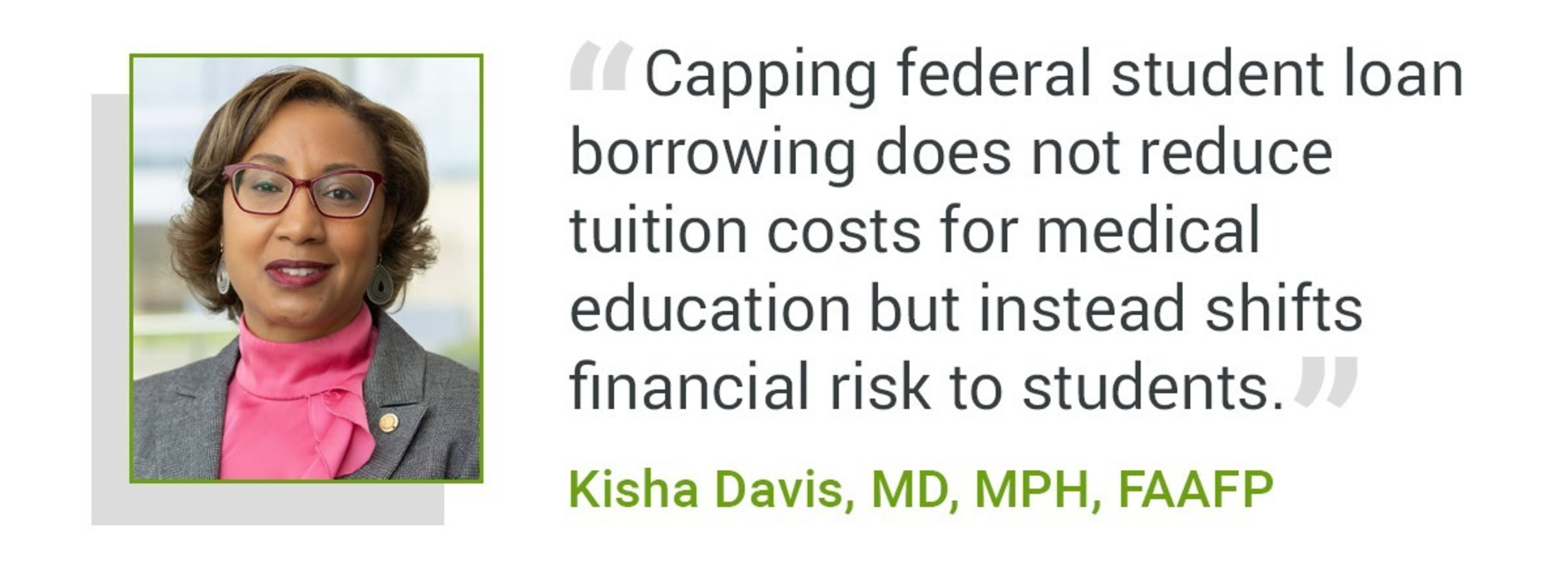
The bottom line is that capping federal student loan borrowing does not reduce tuition costs for medical education but instead shifts financial risk to students, particularly those from low- and middle-income backgrounds who are disproportionately likely to choose primary care careers.
Healio: How could this affect the primary care workforce?
Davis: Student debt already plays a major role in specialty choice. Family physicians and other primary care doctors generally earn less than many subspecialists, so financing matters.
If medical students face higher borrowing costs or greater financial uncertainty, some may decide that primary care simply isn’t financially feasible. That’s deeply concerning at a time when the U.S. is already projected to face a shortage of up to 40,400 primary care physicians by 2036.
Patients already, and will continue, to bear the brunt of the primary care workforce shortage, facing longer waiting times, difficulty finding a doctor and even care delays, especially in rural and under-resourced areas.
Read the full article on Healio.