
‘Inaction is not an option’: Focus on clinician wellness essential for quality care
By Mark Leiser
Fact checked by Heather Biele
Jennifer Bickel, MD, had established herself as a nationally respected headache specialist by the time she assumed a new leadership role at Children’s Mercy Hospital in 2018.
While serving as medical director for the institution’s Center for Wellbeing, she implemented system changes and developed programs that promoted a culture of belonging and supported staff resilience.
Two years later, she led a team charged with supporting the well-being of staff members amid the COVID-19 pandemic.
Those experiences sparked a new passion and prompted her to pivot.
She left her clinical role in 2021 to become Moffitt Cancer Center’s first chief wellness officer.
Four years later, she moved into the same position at The University of Texas MD Anderson Cancer Center, where today she leads efforts to support and enhance the mental health and well-being of the institution’s approximately 27,000 employees.
Since making the transition, Bickel has learned the ability to improve the well-being of people who work in health care provides her with an opportunity to affect the care of many more patients than she ever could had she remained a clinician-educator.
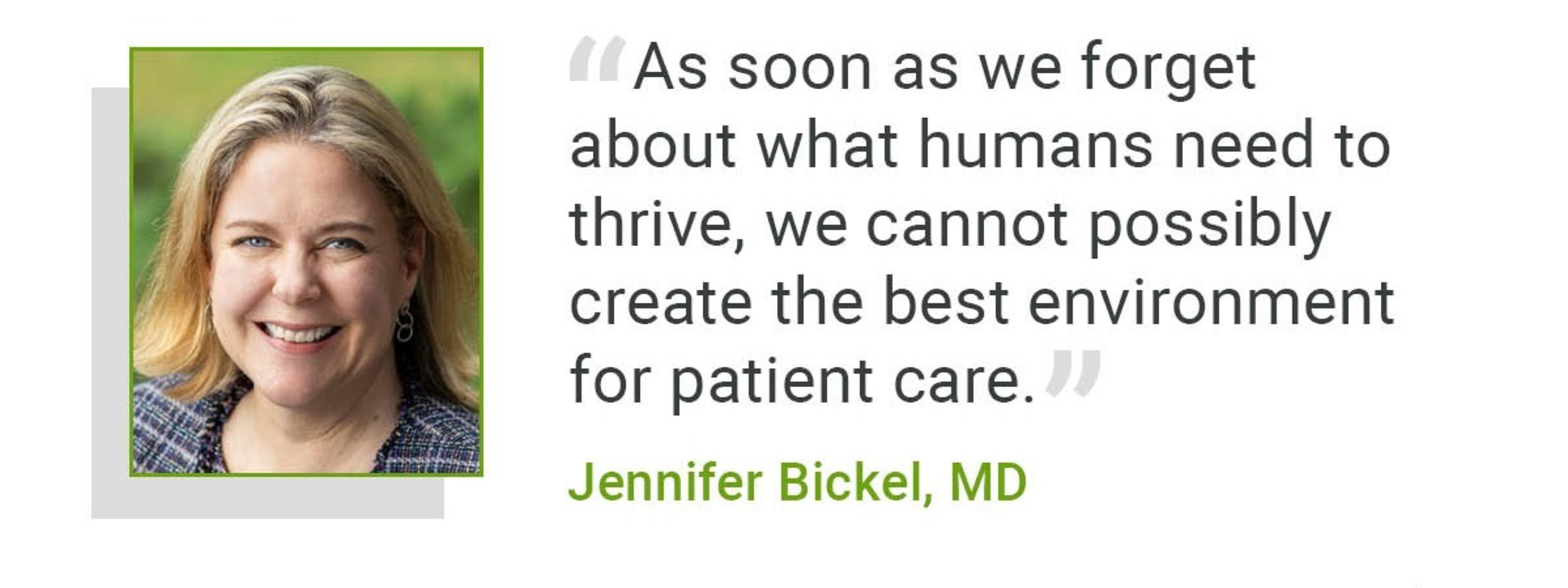
“Our profession is based on humans taking care of other humans,” Bickel told Healio. “As soon as we forget about what humans need to thrive, we cannot possibly create the best environment for patient care.”
August is National Wellness Month, an annual campaign that encourages organizations and individuals to prioritize self-care, reduce stress and establish healthier habits.
As that observance nears, Healio spoke with Bickel about why wellness is essential for people who work in health care, why successful work in this space is both visionary and disruptive, and the advice she would give to others in the field to help them drive change.
Healio: What prompted you to transition from clinician-educator into a wellness role?
Bickel: Becoming a chief wellness officer had never been on my bingo card. I had been a practicing academic physician who cared very much for taking care of patients. But, as a growing leader, I continued to see how burnout was a foundational barrier to being able to provide quality clinical care. Physicians have twice the rate of burnout as the general population, even though they have higher levels of resilience. I didn’t come into wellness from the traditional background of yoga, meditation or lifestyle medicine. I came into it because of a passion for clinical care delivery.
Healio: Are there misconceptions about wellness within the clinical community?
Bickel: There are a lot of misunderstandings. This is not just about making people happier. It is about ensuring we can all be at our best because of our mental and physical well-being so physicians, nurses and other members of the care team can truly give their full selves to patients — through compassion, their cognitive abilities and everything in between.
In many ways, “wellness” has a connotation problem. It does not mean a “perfect life.” It does not mean the absence of challenges, hard work or discomfort. This is about creating environments in which we can truly grow and thrive.
How the clinical care team feels, and how they are functioning, directly relates to the care patients receive. Health care settings are not set up to prioritize that. Also, mental health stigma is higher in health care than it is in the general population. We must recognize that mental health support requires removing the barriers that that deter clinicians from seeking help.
Healio: Has the pendulum started to swing?
Bickel: We have come a long way, but there is still a long way to go. When I went through training about 20 years ago, the idea of wellness was nowhere around. The attitude was more like, “How little sleep can you get and still function?” We prioritized survival but we did not recognize that we needed to be able to be our best selves.
We are seeing more recognition that this is important, but there are still misunderstandings about what it takes to get there. That is why models such as AMA’s Joy in Medicine Health System Recognition Program and National Academy of Medicine (NAM)’s Action Collaborative on Clinician Well-Being and Resilience are so important. They provide the consensus and recommendations we need to address this.
Healio: Do you encounter any skepticism?
Bickel: A large part of what I do involves being in contact with and learning from other people in the health care field across the country.
UT MD Anderson is part of the Healthcare Professional Well-being Academic Consortium, a group of academic organizations that are committed to advancing the well-being of health care professionals. I’m on the board for CHARM, the Collaborative for Health and Renewal in Medicine, which is a national group of wellness leaders in medicine. I also lead wellness for the American Academy of Neurology and I’m on faculty for the American College of Healthcare Executives.
Since taking on wellness, I have had over 500 hours of one-on-one or small-group discussions on burnout with physicians and other health care workers from across the country. These interactions have revealed a wide range of “where people are” with this concept.
Through the course of these conversations, I have encountered a lot of skepticism. Some still roll their eyes and think it’s not legitimate. Others say things like, “This would be really nice to do once we have enough time or enough resources to prioritize it.” And then there are people, very much like us, who know you cannot be the best without treating your people the best.
Healio: You once said wellness initiatives — when done right — are visionary and disruptive. What did you mean by that?
Bickel: They are visionary because, once they are in place, you can’t go back. It is so obvious that they are necessary. They also disrupt some of the cultures of medicine. For years, medical training was basically a form of hazing. We have learned we have to be more supportive and acknowledge humans have limits. As we move forward in this effort — looking at how workflows are managed, for example — we undoubtedly will have to disrupt other aspects of this culture.
Healio: What strategies have you implemented since joining UT MD Anderson that other institutions might consider replicating?
Bickel: The first step is to acknowledge that there is no silver bullet that will solve this — there are many different solutions. Also, everyone in the organization must understand they own a part of this.
One thing we do that I think is phenomenal is we don’t just talk about burnout. We measure it across the organization through validated metrics. We also have leadership goals that revolve around psychological safety and well-being, and we provide our leaders with frameworks and recommendations for what they can do in that space.
We have certified more than 100 departments whose leaders are doing work to support the well-being of their teams using AMA and NAM frameworks. This is crucial because people sometimes think wellness can be solved by an individual program. We want all leaders and team members to understand they have to use their sphere of influence to increase the opportunity for well-being.
We only succeed in these efforts because our executive leadership team believes in their importance. The wellness office isn’t put in a basement and asked to “fix things.” Our CEO meets with senior leaders across the organization every week. I’m in those meetings and have a seat at that table, which is incredibly important.
Read the rest of the article here.